
The MARBLE/marble Symposium in Marble, Colorado
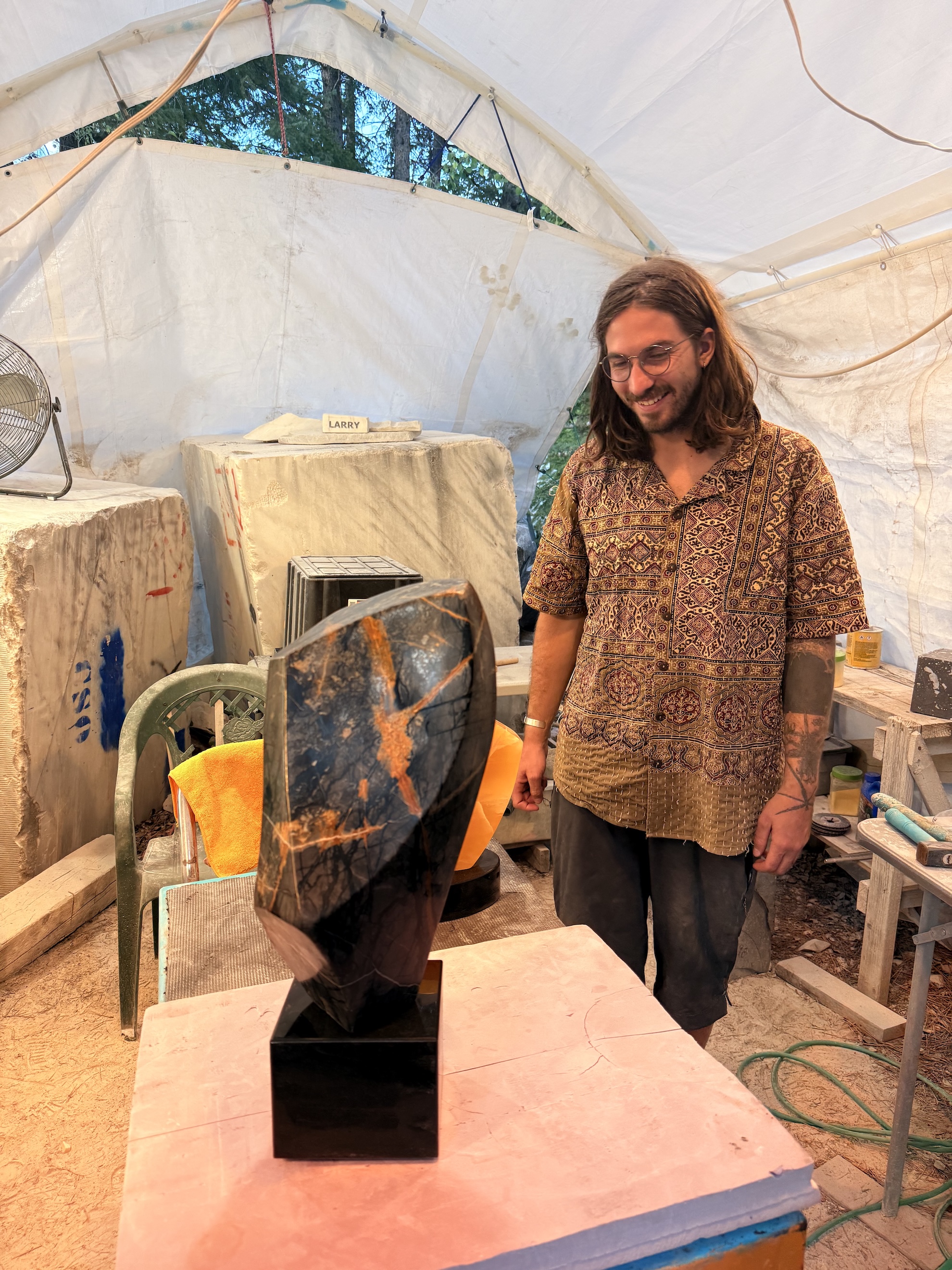
I was elated when my son. Axel Livingston, told me he had received a scholarship to the Marble Institute of Colorado Symposium.
"Go past the Raspberry Inn and take a right," Axel directed me after requesting that I make it over there for the final night celebration of his session at the MARBLE/Marble Stone Carving Symposium, which has gained national and international recognition since its founding in 1989.
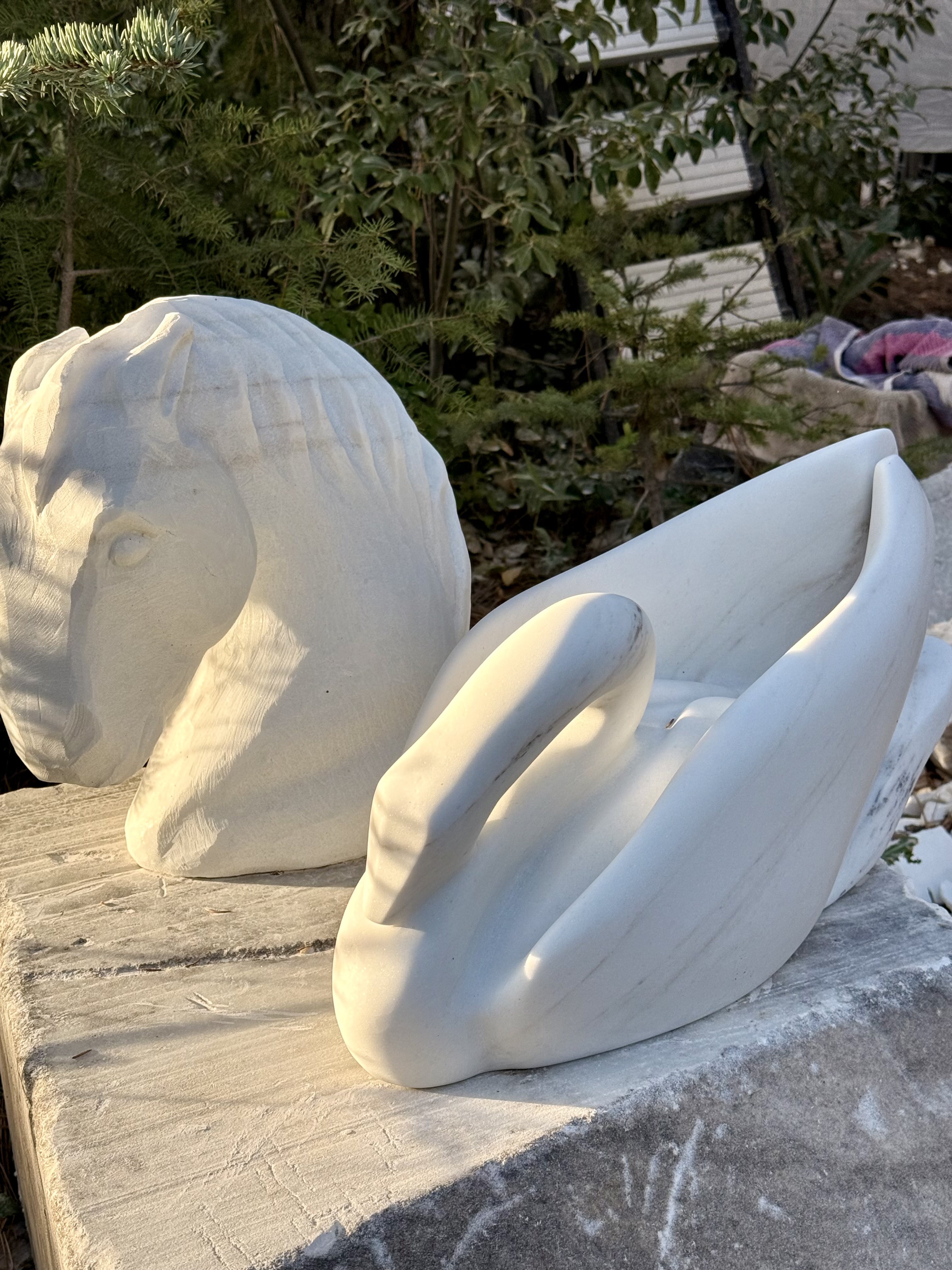
Every summer the event offers three eight-day sessions to sculptors of all interests and skill levels. The sessions accommodate 45 participants and include five teachers, an array of support staff, a tool tent, an outdoor kitchen with cooks whipping up family-style meals, daily workshops on honing the craft of marble sculpting, and massive crystalline blocks of some of the world's whitest Yule marble.
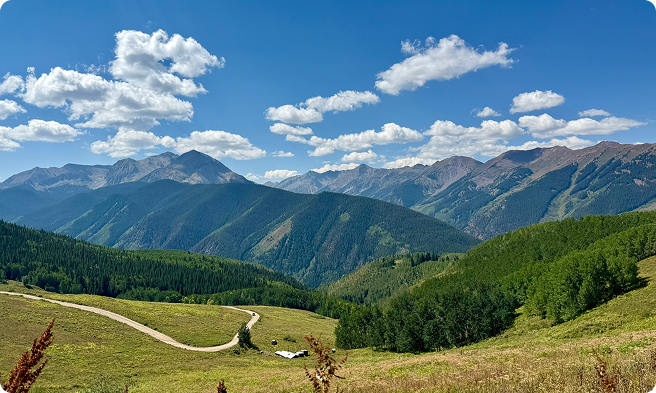
Axel couldn't have been more excited to learn how to carve a new type of stone right near his backyard and he relished the outdoorsiness of it all, students camp out in tents at 8,009 feet of elevation, which included private showers encased in marble slabs. It didn’t bother him a bit that it rained on some of the nights and the temperatures dropped drastically. He stayed snug and warm and it added to the experience.
Located along the Crystal River and held annually in Marble, Colorado, “MARBLE/Marble,” as they affectionately call it, offers daily open-forum classes, demonstrations, and one-on-one guidance from top-tier professional sculptors under open sky. No wifi. No distractions. Just focus and the ability to create in an uncommercialized environment.
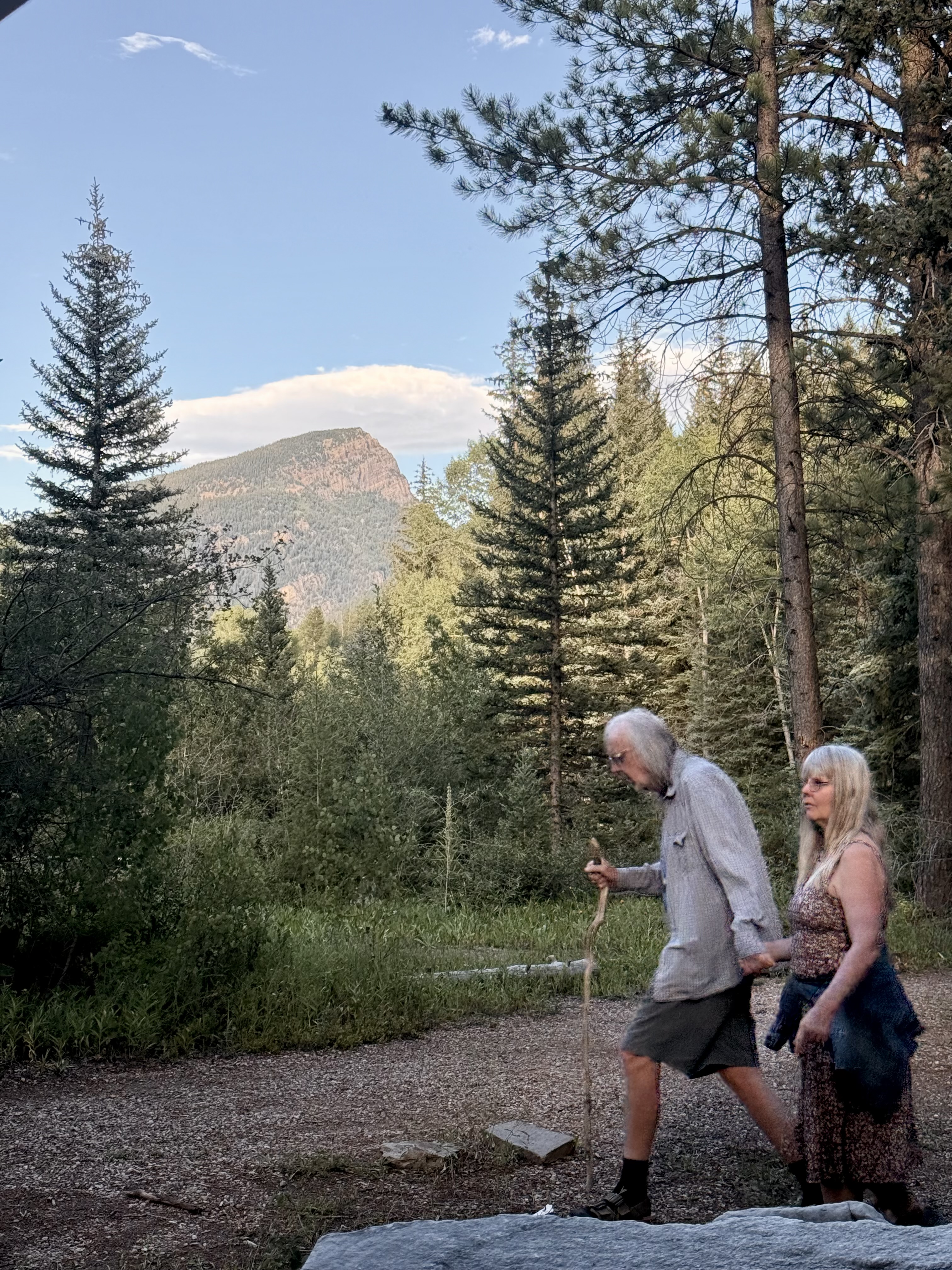
As we headed toward the celebratory dinner, we stopped along the path at a little marble drinking station, which we saw as an invitation, and poured ourselves shots of bourbon in dixie cups. It felt as though we had gone back in time, in the best possible way. Walking into the makeshift kitchen located under one of the few shanty-like structures, we helped ourselves to the homemade lasagnas and sat down with Axel and his new friends at a marble table assembled together with large metal staples. When we were finished we cleaned our dishes at the dishwashing station.

MARBLE/Marble Founder Madeline Wiener

MARBLE/Marble was created by Madeline Wiener, a sculptor originally from New York, after she partnered with three established stone sculptors: Gregory Tonozzi, Scott Owens, and Gerald Balciar. For 15 years they used whatever marble had been dumped on the ground by the old mill. In the promotional video on their website Madeline describes Marble/Marble as a kind of pilgrimage, "It's like the Haj," she says. "Everybody gravitates to it." After spending an afternoon there, I understood. The artists and teachers, who could be anywhere, come back for the environment and to disconnect and do what they love most, sculpt.
The Marble in Marble, Colorado is the same material that makes up the White House dome and was formed over millions of years from fish bones that settled to the bottom of an ancient sea. When Treasure Mountain rose, the heat and pressure liquified those bones and as they cooled, they crystallized into the luminous white stone that has been quarried in this valley for over a century. The reserve stretches 300 feet high, 300 feet wide, and two miles long.
Alan Brown and the Brewmaster

After dinner we were introduced to some of the teachers who showed us around and brought us to their works. One of them told me that Axel was different from other students who came to school and stayed up late partying, sleeping until noon, missing the workshops, and then going to work hungover. Axel wasn't like that. He was at his station early and stayed late. “He's committed, and that's rare," he said to me.
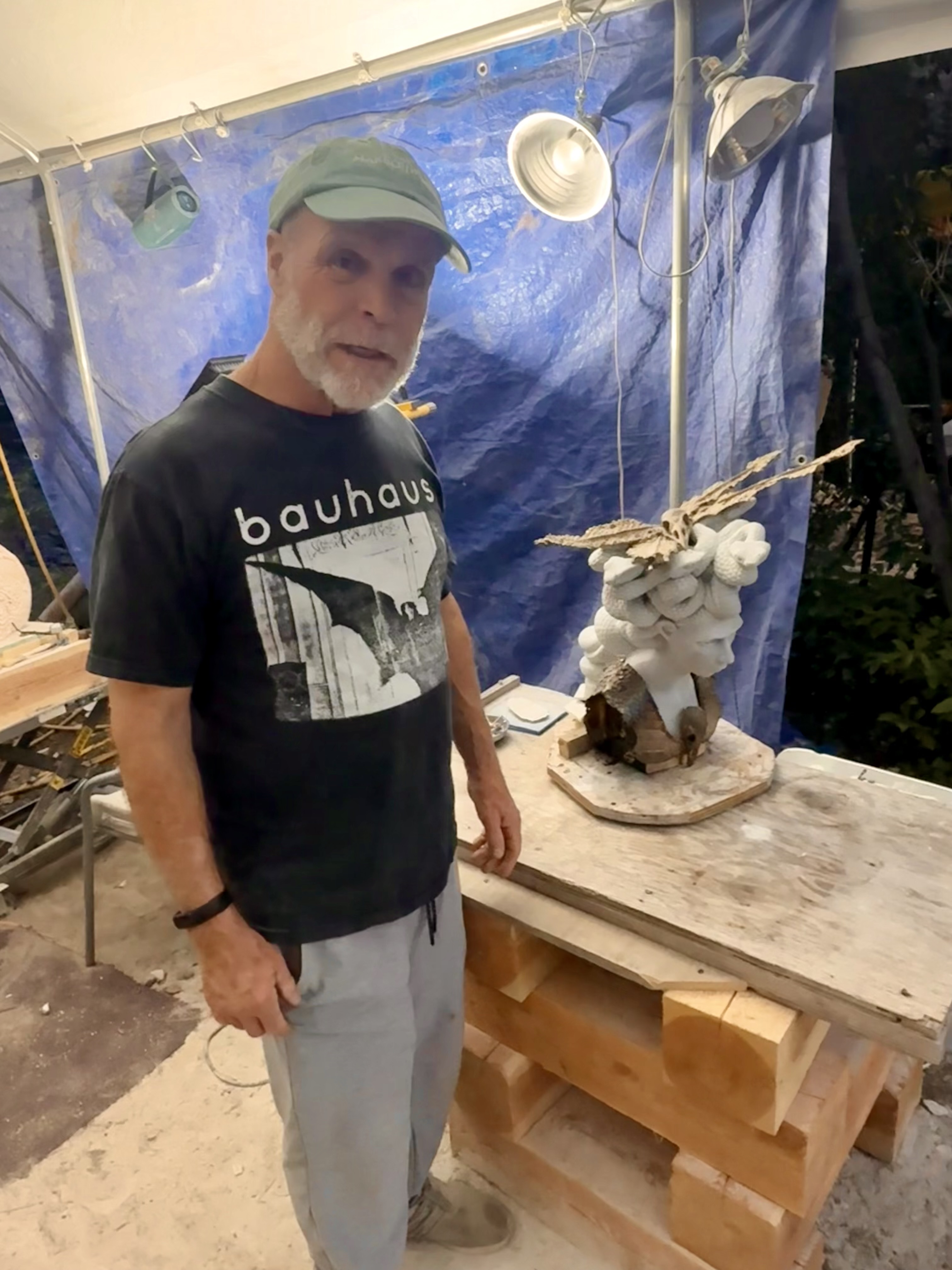
We also had the pleasure of meeting Alan Brown, one of the sculptors, who walked me through his piece: a brewmaster in a wheelchair rolling up the gangplank of a ship, with one bad eye, a big beard, hops in hand, chameleons that mirror the hops, hot peppers, an octopus, an ostrich, and wheat. A whole story carved from stone.
For me, it began at the College for Creative Studies in Detroit, majoring in illustration. After graduating, I quickly decided that illustration was not the path for me. I was drawn to the fine arts and three dimensional work in marble and bronze. I traded a pen for power tools, getting great satisfaction out of the physical demands of working with mediums that have carried such weight, both literally and figuratively, in the art world. You can see the influence of my education in the highly detailed elements of my work. I create life-size figurative sculptures in the neoclassical style. The fantasy themes depict a harmonious relationship with nature, which stems from my 40 year career as a Park Ranger. You can call it escapism from life’s realities, but these mystical creations take me to a different place, using skills old and new to unleash my imagination. — Alan Brown
Alan was an illustrator in college before he transferred everything to stone. One of his pieces was Humpty Dumpty, but instead of shattering to pieces after falling and being put back together again, this Humpty Dumpty had gotten lucky and fallen into a pile of manure. "Without perspective, you really don't know how bad it sucks," he said. "That was a good moment. That was his day." The inspiration came from witnessing his then 300 lb boss fall over and roll while helping to set up a tent. Al still remembers the cleats on his boots, which were incorporated into the sculpture.

When I asked if he had any work in Redstone, he shook his head. "The sales part? … I'd rather give any money I make to my kids." he went on to divulge other things about doing what he loves in the middle of nowhere and how it doesn’t lend itself to finding a life partner. The rest of what he said I shan’t divulge here without his consent. Let’s just say his love for sculpting takes precedence over his love life.
My takeaway from that evening is that true artists are happiest when they are creating and that curiosity is not a choice for them, but rather, it's just how they're wired.
When Axel came home with about ten loads of laundry to wash (sanded marble is extremely fine and gets into everything) he expressed that he might want to work there. But Axel has a world of opportunity and experience ahead of him and I encouraged him to keep exploring and that every experience adds new elements to his work. Glass, iron, ceramics, stone, found objects from forests in Africa and deserts in Arizona, it all ends up in something he makes, and the more he sees the more inspiration he’ll have.
Why This Matters
There is something beautiful and quietly radical about a place like MARBLE/Marble where we shared the dancefloor with a hip shaking, glittery, costumed crowd of Marble locals, faculty and students, all to the same band that has been playing at these final night receptions for over 35 years.
MARBLE/Marble has no interest in your portfolio or your marketability. It has no interest in your social following or your brand. It is, as one teacher described it, "an organic environment and a mini vacation from reality." It is the opposite of everything the attention economy tells us we should want. The Marble Institute of Colorado is, in the most literal sense, a community built entirely around the love of creating.
If you have someone who needs to be reminded what it feels like to do something purely because you love it, send them to Marble/Marble. It's the first right past the Raspberry Inn.
Learn more and support the Marble Institute of Colorado at marblemarble.org. MIC is a 501(c)(3) nonprofit and donations are fully tax-deductible.