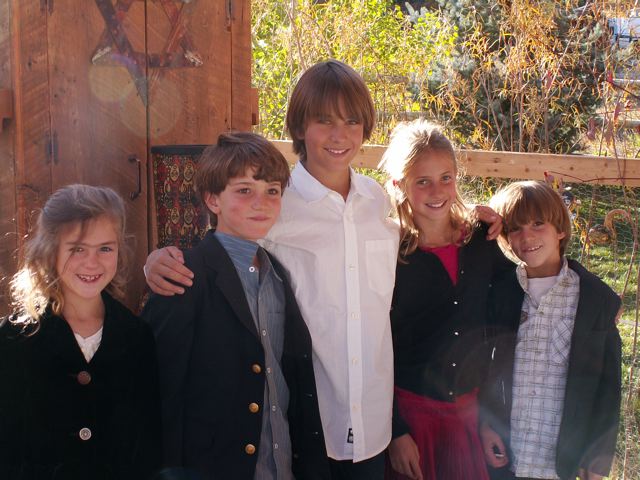

When Baddy and I were freshly married, we were on our way to a Livingston family reunion, staying at the La Quinta Inn. On the way, we stopped for a family dinner at the Burger King drive-thru. I looked at Baddy and the three boys chomping their gum and said, “Ya know, Baddy, I don’t really do La Quinta.” “Well, ya do now,” he sang cheerily while hucking a loogie out the window. “Whatever happened to the Jewish princess my father raised me to be?” I asked. “Oh, don’t you worry,” he guffawed. “Once a princess, always a princess,” and he squeezed that spot on my knee that makes me scream and jump out of my seat.
Every year, when I pull the two boxes out of the attic, one filled with ornaments for the Christmas tree and the other with Jewish ornaments for the Chanukah bush, plus a menorah and a Star of David, I can’t help but wonder about the confusion my children must feel having parents of different religions, Baddy a Presbyterian and I a Jew from Massachusetts. Had I married a Jewish man, would life have more meaning for my children? Would they be calmer because of an inner peace?
Growing Up Conservative
Growing up Conservative, my parents took us to temple on the High Holidays, and although the services were painfully long and boring and not geared toward children, I loved sitting next to my handsome father as he sang the songs from the prayer book. I felt safe in his strong, steadfast presence, breathing in his cologne and playing with the shiny gold cuff links my German grandmother had given him. It didn’t matter that I found absolutely no meaning in the prayers.
When we needed a break, my sisters and I would push open the enormous doors and burn off our energy running around outside in our beautiful dresses, looking for trees to climb, and then hang out in the bathroom playing with all the expensive soaps. Somehow the songs and the Hebrew words spoken by the rabbi seeped into my being and became part of my soul, but I never truly understood the full meaning of being Jewish.
I endured my horribly nervous Hebrew school teacher, who would scream at me to shut up every time I flirted with the dreamiest boy in my class, Steven Goodman. Any kind of school was easier to endure with boys around to flirt with. My friends and I did what we could to stay awake, passing notes back and forth as she paced the classroom yelling at us and rapping her yardstick on our desks. “Sheket!” she’d cry. Saying “be quiet” in Hebrew seems to be the most significant thing I learned from her.
I had a bat mitzvah because it was par for the course in my hometown and it meant everything to my parents, not to mention that I was rewarded with the best party I ever had, with my very own DJ, a disco ball and flowing gifts. I’d like to think my inability to appreciate the significance and spirituality of my training was due to incredibly dull teachers; I couldn’t live with placing all the onus on myself.
If only I had been lucky enough to have a teacher like Tal Ben-Shahar, whose Positive Psychology course became one of the most popular classes in Harvard’s history, teaching students how to create fulfilling, flourishing lives: “Learn to fail or fail to learn.” It saddens me that in all my hours studying the Torah at such an impressionable age, no one interpreted its ancient words of wisdom for me.
Living on a Kibbutz
It wasn’t until I traveled to Israel with my sister that I found a deep love for the Israeli people and Judaism. We had never been to an armed country before, and the sea of soldiers with huge guns slung across their shoulders was disconcerting at first. But the soldiers were beautiful, most of them our age, and we shyly flirted with them, admiring their strong bodies, sparkly green eyes and olive skin. It didn’t matter that their big, warm smiles were marred by teeth full of sunflower seed shells. We soon got used to being guarded and came to rely on their presence to keep us safe.
We lived on a kibbutz and worked the hardest I had ever worked in my life, which, at that point, wasn’t saying much. We visited the Dead Sea and watched very white tourists pretending to read the newspaper while floating like big fat otters on their backs. We hiked in leopard country in the Negev Desert, playing in the lush oases and waterfalls hidden behind the desert walls. We walked through the markets of Tel Aviv while butchers beckoned us from shops with headless goats hanging from the ceilings. We placed prayers for the aunts and uncles we lost in the Holocaust between the stones of the Western Wall, and we fell in love with the magnificent gardens sprouting from the dry, desolate desert. We were filled with enormous pride to be connected to the Israeli people and their culture.
Two Holidays, One Home
Over the years, I’ve also grown to appreciate my husband’s religion, and it was my time with Reverend Dr. Stephen-Poos Benson that gave me a much greater appreciation for the spiritual meaning behind Christian teachings. What I know, as a Jew married to a Christian, is that I’m living in paradise in my mixed marriage, and those who live with hatred aren’t truly living and will never experience the beauty of what life is all about.
With Chanukah here and Christmas rapidly approaching, I feel the pressure building once again to create a heartfelt, festive and spiritual atmosphere at home, just as our mothers did when we were growing up. But it’s not easy to bring on the magic of both holidays, and since I can’t focus on just one, I fear I’ll inevitably fail at both. A worrisome problem.