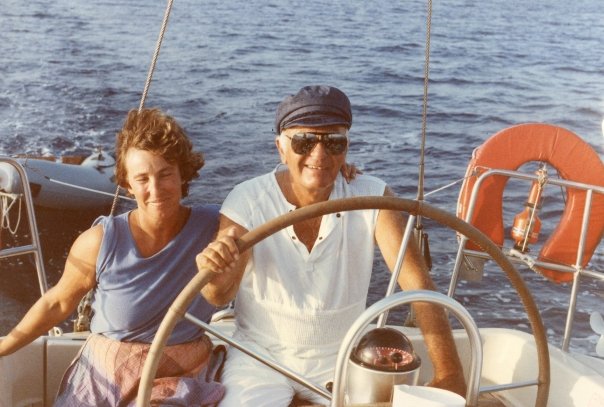
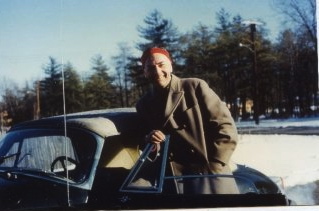
My father, Harold Melvin Wernick, was born in 1917 and lived through two wars and the Great Depression. A tall, sporty man with a shark grin and a mischievous twinkle in his baby blues, he was single into his forties and had a treasure chest of photographs telling tales of his bachelor life, skiing in Switzerland with one gorgeous woman and sailing in the Netherlands with another. He was quite the eligible playboy. But romancing multiple women at a time came to a dead stop when he met our mother, Nicolette Atlas.
At nineteen, Nicolette, nicknamed Nicky, had just flown from her life in England to work for a division of Brevitt Shoes in the Empire State Building in New York City. A huge departure from the elegant American women Harold had been showering with affection, Nicky was different. There were no pretensions with this one. Very young and naive from her sheltered childhood, and deeply homesick for Gerta, who was still back in England, she was his biggest challenge. For Nicky, Harold, with his American charm, adoration, grace and adventurous spirit, was unlike anybody she had ever met, and he awakened her to a luxurious, vital world of adventure and travel. But he wasn’t the only man after her affections, and he had to work hard on Arthur and Gerta to win her over.
Gerta, a strong and positive force in my mother’s life when she was well, was the one who convinced Nicky that marrying Harold was the right path. Not only did he have beautiful long, black, silky eyelashes, which would make for beautiful children and grandchildren (which of course was most important), but he was a strong, funny and confident man. He was also my mother’s antithesis: grounded, solid, straightforward and charging through life with purpose. On a rainy day in June they wed, and my mother wept, begging to spend the first two days of their honeymoon with Gerta. My father, lovestruck and confused, consented.
Three Daughters
Then we came, the three daughters, and it didn’t take Harold long to realize he was in deeply over his head with a wife half his age and three baby girls his traditional upbringing would never let him relate to.
My sisters and I, and our mother, consistently pushed him past his threshold with our rambunctious tomboy behavior, always finding the noisiest activity, from belting out the Jesus Christ Superstar album at the top of our lungs to parading through the house as a marching band, smashing together the largest, noisiest pots and pans, or wrestling and tumbling through the house and through the upscale resorts of Europe we visited on our travels.
My mother never wanted to leave her daughters behind at camp, so summers were spent traveling together on luxurious vacations our father planned. We stayed at the “poshest” (Harold’s favorite expression) resorts in Europe: the Waldhaus in Sils-Maria, Switzerland, Marbella, Capri, St. Tropez, Zermatt, Barcelona, Ramatuelle. We lived the lives of princesses in an enchanted but often tempestuous world.
I believe now that Harold felt like an outsider in a young female world, and it sometimes got the best of him, tipping him over the edge when we least expected it over something innocent, like wrestling a bit too much and spilling our tortellini soup or not finishing our strawberry shortcake. The female harmony would be broken as he unleashed his temper on us, standing up and waving his arms as he shouted about the ridiculousness of our behavior, usually embarrassing us to tears as the patrons of the upscale restaurants stared in pity and disbelief. But every fairy tale has its dark side, or it wouldn’t be a fairy tale.
As teens, we didn’t tolerate his turbulent intrusions. We either added fuel to his fire by shouting back or escaped his tirades with our friends and our pints of blackberry brandy into our beloved woods to drink away the pain and seek comfort from the bottle… and from the boys who were there to support us.
With time came the understanding that our father’s frustrations lay not only with us but also with our mother, who lived for her children and her friends. At times we pitied him for living on his own island amid a sea of women. At other times, he reeled those he had pushed away back in by making us laugh until we cried with his charm and witty humor. If only my mother had slipped him that little blue pill earlier in life, he might have been better equipped to make light of the frustrations of being a father of three girls and the husband of a wife who forever remained an enigma to him.
Oblivious to the fact that we all shut out his noise as best we could by escaping to other worlds or leaving the house, he’d lecture us for not taking life seriously. “Life is not about having fun,” he’d bellow, hands animated. That advice, coming from a man who didn’t settle down until his forties, was very hard to take seriously. If life wasn’t all about fun, then why did he marry a woman twenty-one years his junior?